
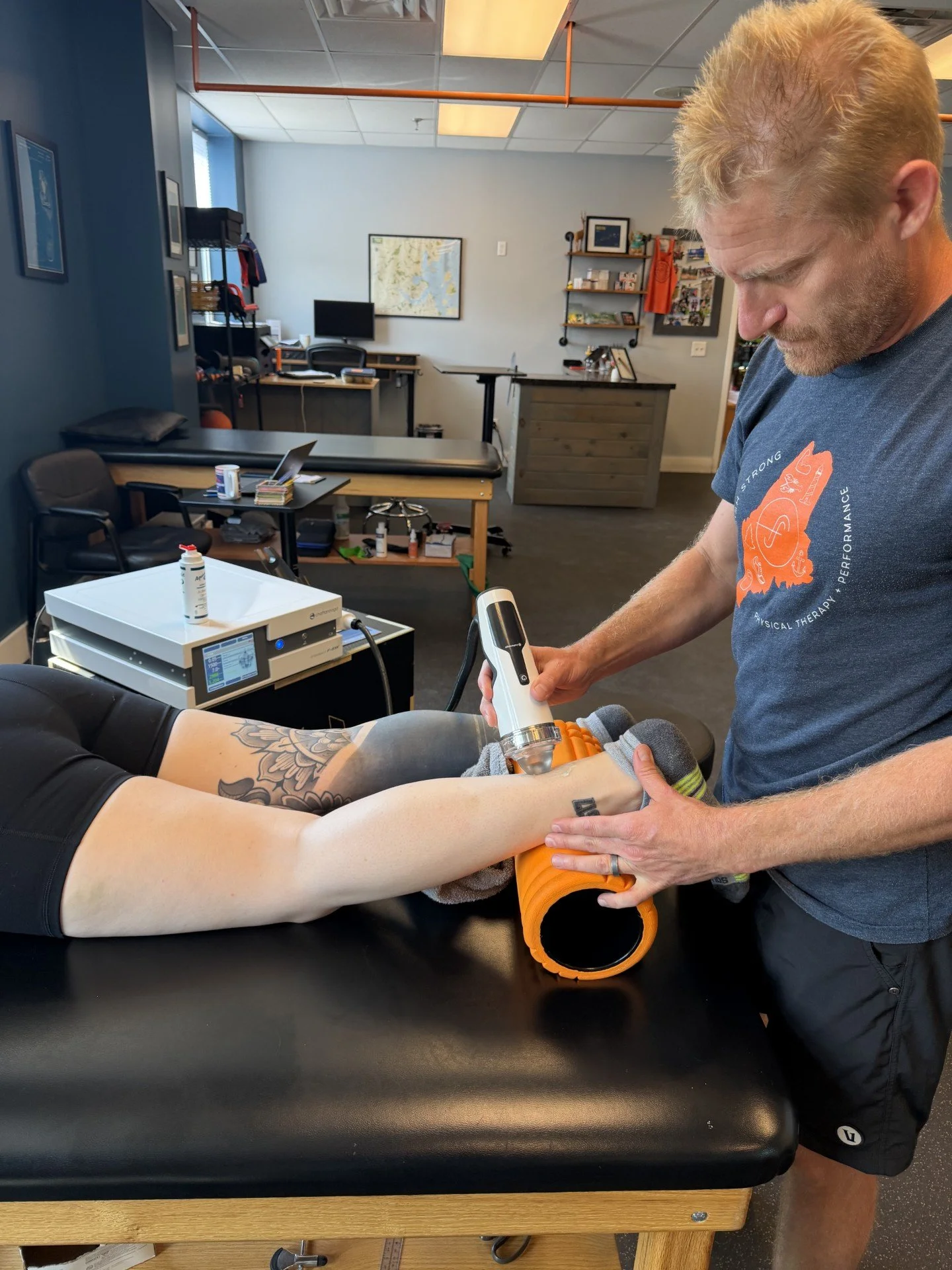
Finish Strong is excited to offer shockwave therapy as part of our treatment plans. Keep reading to learn what shockwave therapy is, whether you’re a good candidate for it, and how our approach to using it differs from that of many clinics.
What is Shockwave Therapy?
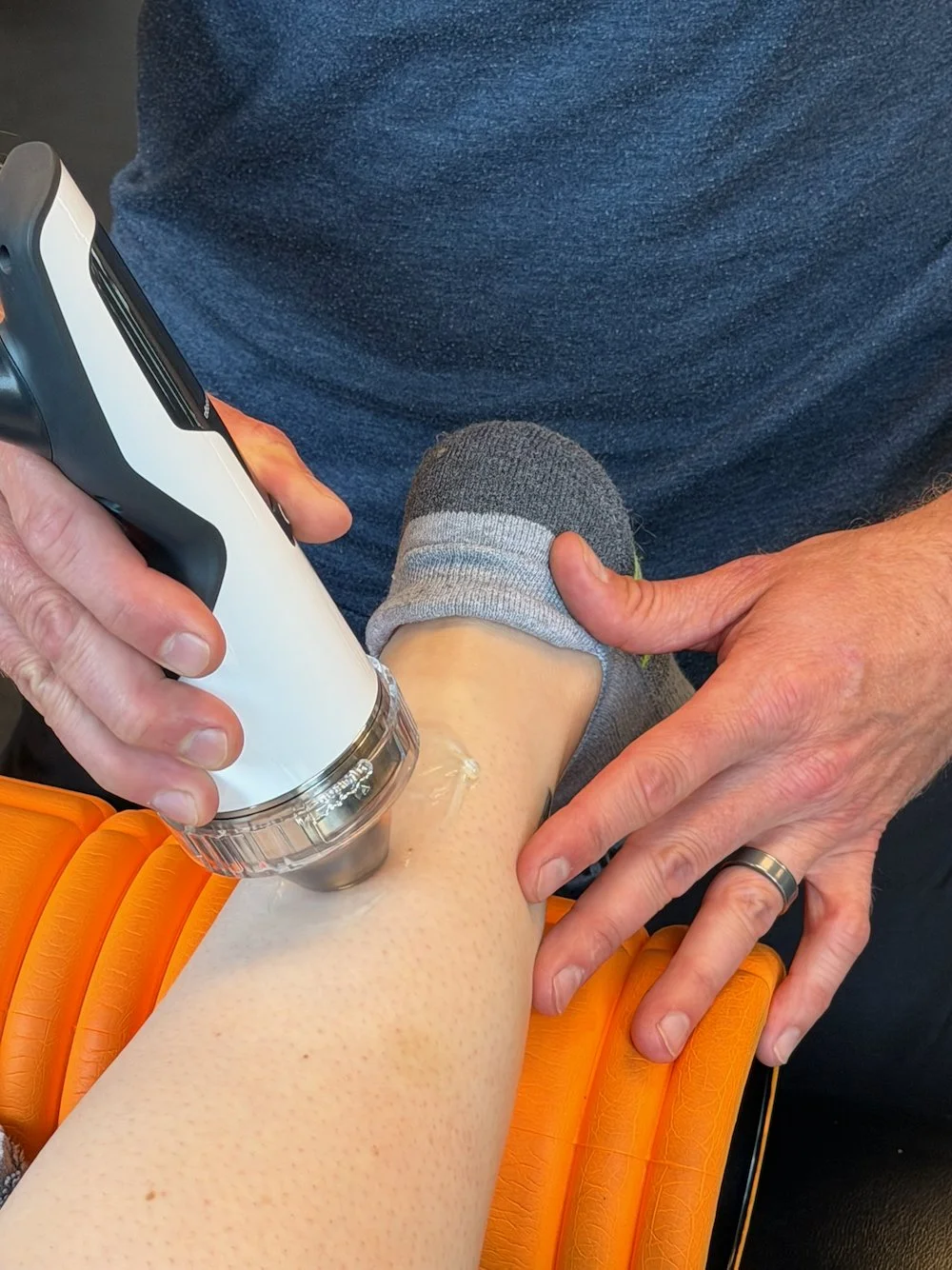
Shockwave therapy entails using an applicator to deliver brief, high-energy acoustic pulses through the skin. Shockwave is similar to traditional ultrasound, which also sends soundwaves through the skin. But, with the help of electromagnetic waves, shockwave pulses can be more directed by the care provider. Shockwave pulses can go deeper and be more targeted, making it a more specific treatment than ultrasound waves, which spread throughout the body.
Researchers are still figuring out exactly how shockwave can speed healing. Some possibilities include:
• Triggering collagen/protein synthesis and other aspects of tissue remodeling
• Increasing blood flow to tissues with low blood supply
• Reducing inflammation
• Stimulating bone growth
At Finish Strong, we use focused shockwave, which penetrates deeply through the skin to reach targeted injured tissues. We consider focused shockwave to be more effective than its alternative, radial shockwave, in treating the types of athletic injuries we most often see.
What is Shockwave Therapy Best Used For?
On the basis of published research and our observations, we currently use focused shockwave most often to treat long-term tendon problems. Known as tendinopathies, these injuries are different than tendinitis, which are a milder, earlier form of tendon injury that can often resolve quickly by getting the initial inflammation under control. Tendinopathies can develop when tendinitis becomes more chronic. In those cases, there are structural changes to the tendon, such as degraded collagen and reduced blood flow. Tendinopathies respond best to slowly rebuilding the tendon’s capacity. Shockwave therapy can accelerate that rebuilding by inducing regenerative cellular changes. Examples of tendinopathies we use shockwave on are in the high hamstring, glute, elbow, shoulder, knee, and Achilles. Also, although the plantar fascia isn’t technically a tendon, we’ve found that shockwave can be similarly useful in cases of long-term plantar fasciitis.
There’s also growing clinical and anecdotal evidence that shockwave therapy can help with bone stress injuries. The thinking here is that shockwave can stimulate bone cells to regenerate more quickly than they otherwise would.
We’ve found that shockwave can help reduce acute pain from other types of injury. But in these cases, the relief is short-term, probably because shockwave inhibits pain receptors and temporarily reduces inflammation, rather than because shockwave is triggering structural changes.
Shockwave shouldn’t be used if you have a bleeding disorder, because the stress of the treatment could increase bleeding within tissues. Shockwave also shouldn’t be used around the growth plates of adolescents, because of the treatment’s potential to spur bone growth.
How Often Should I Get Shockwave Therapy?
Our typical protocol is to start with three shockwave sessions, spaced one week apart. If you don’t notice any improvements after those three sessions, we’ll discuss whether to continue incorporating shockwave into your treatment plan. If you do notice improvement after three sessions, we’ll probably recommend two more sessions spaced one week apart. After those five weekly sessions, if we think you’ll benefit from more shockwave treatment, we’ll likely recommend spacing appointments two weeks apart. After eight or so sessions, we should have plenty of evidence whether shockwave therapy is helping you.
All of our initial appointments are 60 minutes long. During your first session, we’ll do a thorough case history and evaluation and create a personalized treatment plan, which will include at-home exercises. After that, many patients have regular 30-minute follow-ups. These shorter sessions are perfect if shockwave therapy is part of your treatment plan. In that time, we’ll discuss how your body and still have time for shockwave therapy, which typically lasts for six to ten minutes.
What Will I Feel During a Shockwave Session?
Shockwave may cause some pain during the six to ten minutes that we’re applying it. On a scale of one to ten, we don’t want that pain to exceed a five out of ten. As with all of our in-person treatments, communication is vital. Let us know if the discomfort is too much; we can alter the settings to reduce the intensity.
We keep notes on the settings we use in each shockwave session. As your injured area starts to improve, your body might be able to handle a higher intensity of therapy at the same discomfort level. That said, session-to-session variation in shockwave settings is normal. For example, if you’ve done a hard workout in the morning before a shockwave session, your body might not tolerate as high of a shockwave setting as it would if you had done an easier workout or taken a rest day.
Any intense discomfort you feel during a shockwave session should dissipate almost immediately after treatment.
What Will I Feel After a Shockwave Session?
After shockwave, some patients have less pain in their treatment area, and some have more. And that can be true for one person from session to session. So we try not to draw too many conclusions from how patients feel in the hours after shockwave. In general, we advise sticking with your normal activities after shockwave treatment, but keeping volume and intensity low to moderate. By the following day, you should be okay resuming your normal routine.
If you’re in more pain 24 hours after treatment than you usually are, the intensity level of your treatment was probably too high. Keep good notes on how you feel and discuss them with us at your next session. Stick to shorter and easier workouts until your injured area feels like it usually does.
Some patients report significant relief in their long-term pain after one or two shockwave sessions. These near-immediate improvements are most likely to be short-term; it’s highly unlikely that the tendon remodeling we’re trying to accomplish will happen in that time frame. Of course, we’d rather have you be in less pain. But from our standpoint, the real benefit to any relief you feel after one or two shockwave sessions is this: Reduced pain will make it easier for you to execute the at-home parts of your treatment plan. Which leads to ….
How Does Shockwave Fit Into My Overall Treatment Plan?
At Finish Strong, our approach is different from that of many facilities, where a patient might have a series of 10-minute shockwave sessions over a number of weeks but not be provided a complete program for addressing their injury. We view shockwave therapy as an adjunct to—not a stand-alone substitute for—diagnosis, progressive loading, strength/capacity work, and return-to-sport planning.