
3 Signs You Need To Bee Seen If You Are A Thrower
If you’re a thrower, pain and performance changes aren’t just “part of the game”, they’re signals. The challenge is knowing which ones actually matter. Here are four clear signs it’s time to schedule a physical therapy evaluation before a small issue turns into a season-ending problem.
1. Shoulder and/or Elbow Pain While Throwing

Physical Therapist Matthew Somma assessing shoulder range of motion in a middle school pitcher.
Pain in the front of the shoulder (often around the biceps tendon) or deep in the back of the shoulder is one of the most common early warning signs. Front shoulder pain is often linked to biceps tendon irritation, especially during late cocking or follow-through. On the other hand, posterior shoulder pain, especially pain that feels sharp or “pinchy” in the back of the joint, can be a sign of posterior shoulder impingement. This is often felt in the late cocking phase at maximal shoulder external rotation or the lay back position.
Both typically stem from a combination of workload, mobility restrictions, strength deficits and subtle mechanical inefficiencies. If ignored, these issues don’t just linger, they often progress into rotator cuff problems or labral irritation.
Pain on the inside of the elbow is never something to brush off. In younger athletes, this can point toward Little League elbow (growth plate irritation). In older athletes, it raises concern for stress on the UCL. Even if the pain feels mild or only shows up after throwing, it reflects excessive valgus stress at the elbow, often due to poor force transfer from the shoulder and trunk or limited mobility upstream.
The key point: elbow pain is often a symptom, not the root problem. Waiting it out usually leads to longer recovery timelines later.
2. Loss of Shoulder Internal Rotation or Elbow Extension
If you suddenly can’t rotate your shoulder inward as far, or your elbow won’t fully straighten, that’s a red flag. Throwers commonly develop adaptations over time, but a noticeable or rapid loss of motion, especially compared to your baseline, is different. Loss of shoulder internal rotation (often called GIRD) can increase stress on both the shoulder and elbow. Similarly, losing elbow extension changes arm slot and timing, forcing the body to compensate elsewhere.
These mobility changes often happen gradually, which is why they’re easy to miss without regular assessment.
3. Loss of Command or Velocity
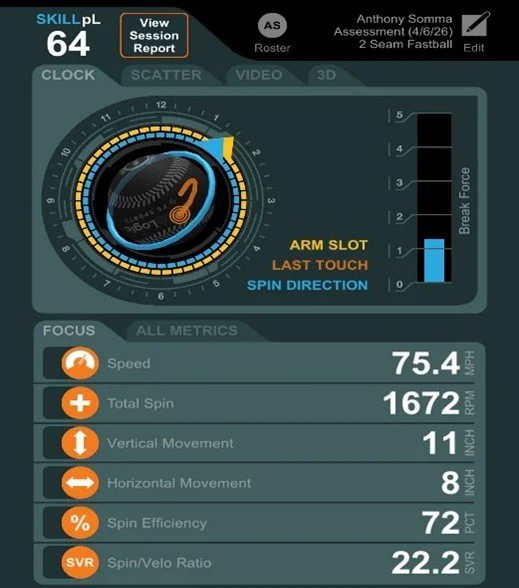
Throwing assessments at Finish Strong Physical Therapy utilize Pitch Logic to assess objective metrics including throwing velocity, spin rate, arm slot and many more throwing specific metrics
Performance changes are often the first sign something is off even before pain shows up. If you’re, missing spots you normally hit, feeling like your arm is “off”, not able to generate your usual velocity, it’s worth paying attention. These changes can reflect underlying issues like strength deficits, mobility restrictions, or inefficient mechanics. In many cases, the body is protecting itself before pain fully sets in.
Addressing the root cause early can restore performance and prevent injury.
Why Early Evaluation Matters
Most throwing injuries don’t come out of nowhere—they build over time. It is usually not just one episode that causes the pain, it is the repetitive cumulative stress over time. Unfortunately, one pitch becomes the tipping point for developing pain. Catching these four signs early allows you to reduce stress on the shoulder and elbow, maintain consistency and performance, avoid long shutdown periods, and stay on the field longer.
A proper physical therapy evaluation doesn’t just look at the painful area—it connects mobility, strength, mechanics, and workload into a clear plan. If you’re dealing with any of these signs, it’s not about shutting things down—it’s about getting ahead of the problem.